Social Projects in Mannheim: Initiatives That Move
Social Projects & Initiatives Moving Mannheim in 2026
From free outdoor training to promoting movement for children and micro-engagements: This overview shows which municipal programs and participation formats in Mannheim can provide orientation in the coming months – and how you can get involved.
Note on up-to-dateness: Times, locations, and participation conditions may change at short notice (e.g., due to weather or holidays). Check the official announcements of the City of Mannheim and the respective organizers before attending.
Why Now: Focus on Movement, Participation, and Neighborhood
In 2026, Mannheim continues to rely on low-threshold offerings that combine health, encounters, and safety. Many initiatives are designed to work without club membership, prior knowledge, and with as few barriers as possible. The goal: more everyday movement, more social participation – and neighborhoods where people know and support each other.
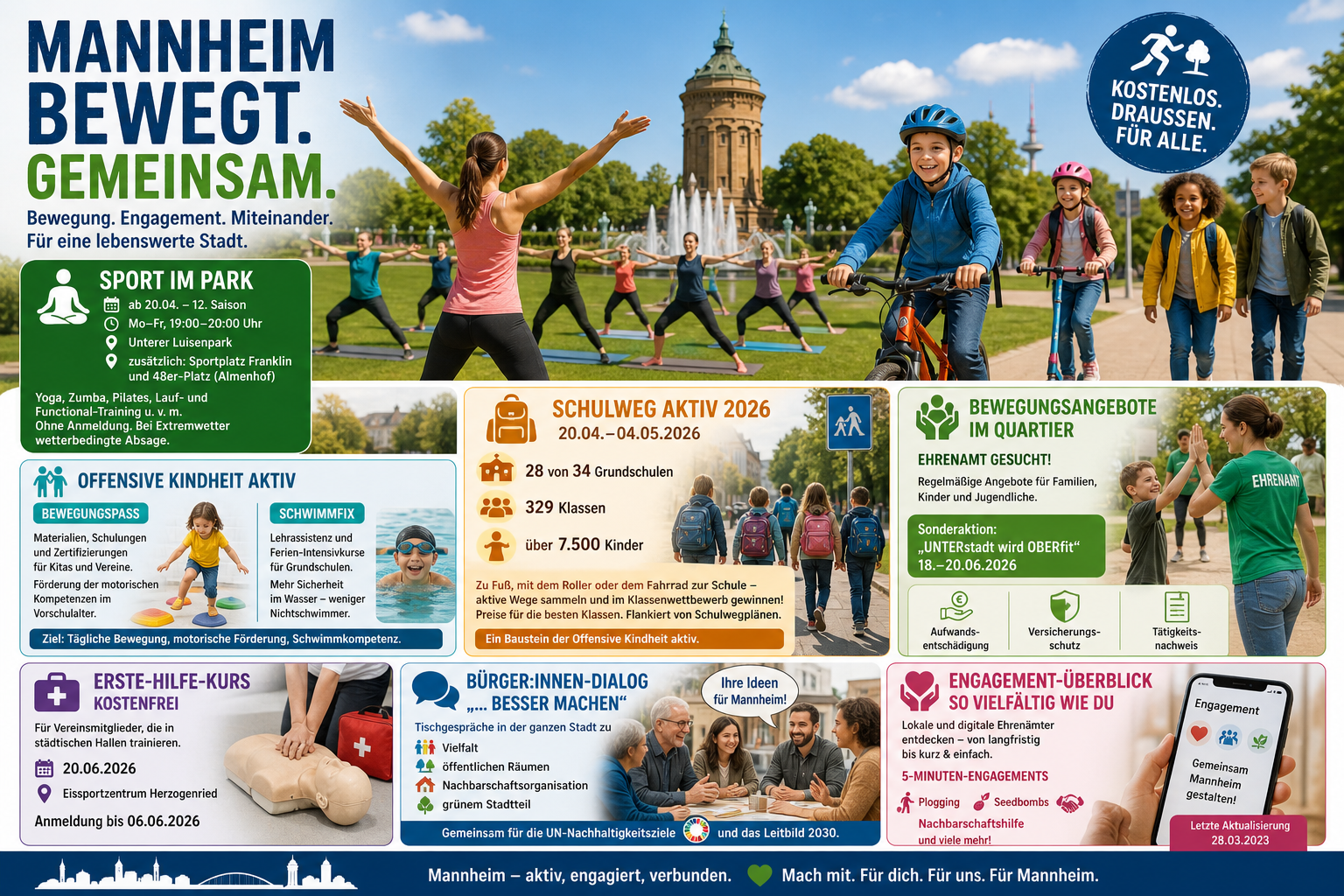
Sport in the Park: Open Training Outdoors (Season 2026)
In the warm season of 2026, Sport in the Park remains one of the most visible movement offers in Mannheim: open, usually free courses in green spaces and public areas. Typical are sessions in the early evening – suitable for everyone who wants to be active together after work or studies.
The Lower Luisenpark is often used as a central setting; depending on the program, other locations such as the Franklin Sports Field or the 48er-Platz in Almenhof may be added. Depending on the course schedule, formats such as yoga, pilates, zumba, running, and functional training are possible in the 2026 season.
How you can participate
- Requirements: usually no registration, no membership
- Bring: comfortable clothing, water, possibly a mat; sun protection in sunny weather
- Weather: in extreme weather, sessions may be canceled at short notice
If you are new to Mannheim, Sport in the Park 2026 is an easy way to experience the city “from the inside”: train together, start conversations, and perceive public spaces as meeting places.
Active Childhood Initiative: Movement, Swimming, and Safe Routes (2026)
A focus of municipal health promotion in 2026 remains the movement of preschool and elementary school children. The Active Childhood Initiative bundles measures to strengthen motor development, participation, and safety in everyday life.
Movement Pass: Anchoring Movement Opportunities in Daycare and School
The Movement Pass in 2026 is aimed at systematically promoting movement in educational institutions – not as a one-off action, but as a recurring part of everyday life. Depending on the design, materials, training, and structured movement impulses can help children be active more often and in more varied ways.
The focus is on playful exercises that can strengthen coordination, strength, endurance, and body awareness. At the same time, many children benefit from recurring experiences of success, more self-confidence, and more stable movement routines.
Swimfix: Learning to Swim as a Participation and Safety Factor
Swimming is a key topic for many families in 2026 – not only as a sport but also as a safety skill. Swimfix is intended as an offer to support schools and children in acquiring swimming skills, for example through accompanying learning opportunities, additional practice times, or holiday formats (depending on capacities and the specific annual program).
It is important to have a realistic view: learning to swim takes time, practice, and reliable conditions. Find out early about ways to participate so that learning progress can be built up calmly.
Active School Route: On Foot, by Scooter or Bicycle – Everyday and Climate-Conscious
The Active School Route campaign in 2026 aims to show how much movement is involved in the daily way to school. Classes can – depending on the current format – document over a campaign period how often the school route is covered without a car. The playful competition can create motivation without competitive sports being the focus.
Typical goals for 2026:
- More everyday movement: the school route as a recurring activity impulse
- More independence: children practice orientation, attention, and routine
- More safety: conscious route choice and clear agreements
- More climate protection: less short-distance traffic around schools
Additionally, school route plans (depending on school/neighborhood) can help identify safe routes. For parents, the most important thing in 2026 is: practice together, agree on clear rules, and gradually transition the route to independence.
Movement Offers in the Neighborhood: When Volunteering Strengthens Communities (2026)
In addition to large programs, local movement offers will especially shape everyday life in 2026: short, nearby activities on squares, in courtyards, at neighborhood meetings, or in parks. Often it is volunteers who help shape such offers – for families, children and young people, or for people new to Mannheim.
For engagement to work well, reliable conditions are needed. In many municipal contexts, this includes clear agreements on assignments, insurance coverage, and – depending on the project – an expense allowance or a certificate of activity. This makes engagement more plannable and more likely in the long term.
Action days under the motto “UNTERstadt wird OBERfit” can bundle additional movement impulses in selected neighborhoods in 2026. The core idea is to make health promotion visible where people live their everyday lives – low-threshold, communal, and without a “fitness studio feeling.”
Qualification & Safety: First Aid as a Basis for Active Groups (2026)
Where people do sports together, prevention and safety play a major role. In 2026, qualifications such as first aid courses for trainers, club members, or volunteers are therefore an important building block – especially when offers take place in municipal halls or public spaces.
The benefit is concrete: those who react calmly and correctly to falls, circulatory problems, or injuries strengthen the sense of security in the group. First aid thus not only increases action confidence but also the reliability of movement offers for children, adults, and older participants.
Citizen Dialogue & Micro-Engagement: Have Your Say and Get Involved in Mannheim (2026)
“… do better”: Table Talks for Everyday Ideas
Participation formats are especially valuable in 2026 when they remain practical for everyday life. Under the motto “… do better”, table talks can create spaces where citizens talk about concrete local topics – for example, meeting places, the use of public spaces, community in the neighborhood, or ways to a greener district.
For such conversations to have an impact, transparency is important: Which ideas will be followed up and how? Which project ideas can start quickly – and which need longer planning times? In 2026, pay attention to notes on documentation and further processing of the results when participating.
Small Actions, Big Impact: Micro-Engagements in 2026
Not everyone can commit long-term. Micro-engagements are a pragmatic answer in 2026: small, manageable contributions that can be integrated into everyday life. These include, for example:
- Plogging: collecting trash while jogging or walking and keeping paths cleaner
- Neighborhood help: short support such as carrying, picking up, or organizing
- Greening impulses as part of local actions: depending on the neighborhood project (please only in permitted, coordinated formats)
If you are starting out in 2026, micro-engagement is often the best beginning: you get to know people and structures without immediately making a long-term commitment.
What You Can Do in 2026: A Short Starter Plan
- Choose a suitable format: outdoor course, neighborhood offer, or participation round.
- Check the official info: dates/locations/registration via the City of Mannheim or the organizer.
- Start low-threshold: a single session or a short assignment is enough to start.
- Stick with it: regularity brings the greatest effect – physically and socially.
This way, a single activity in spring or summer 2026 quickly becomes a fixed part of everyday life – and from many individual participations, a city emerges that keeps itself moving together.