Which Formats You Typically Find in Mannheim
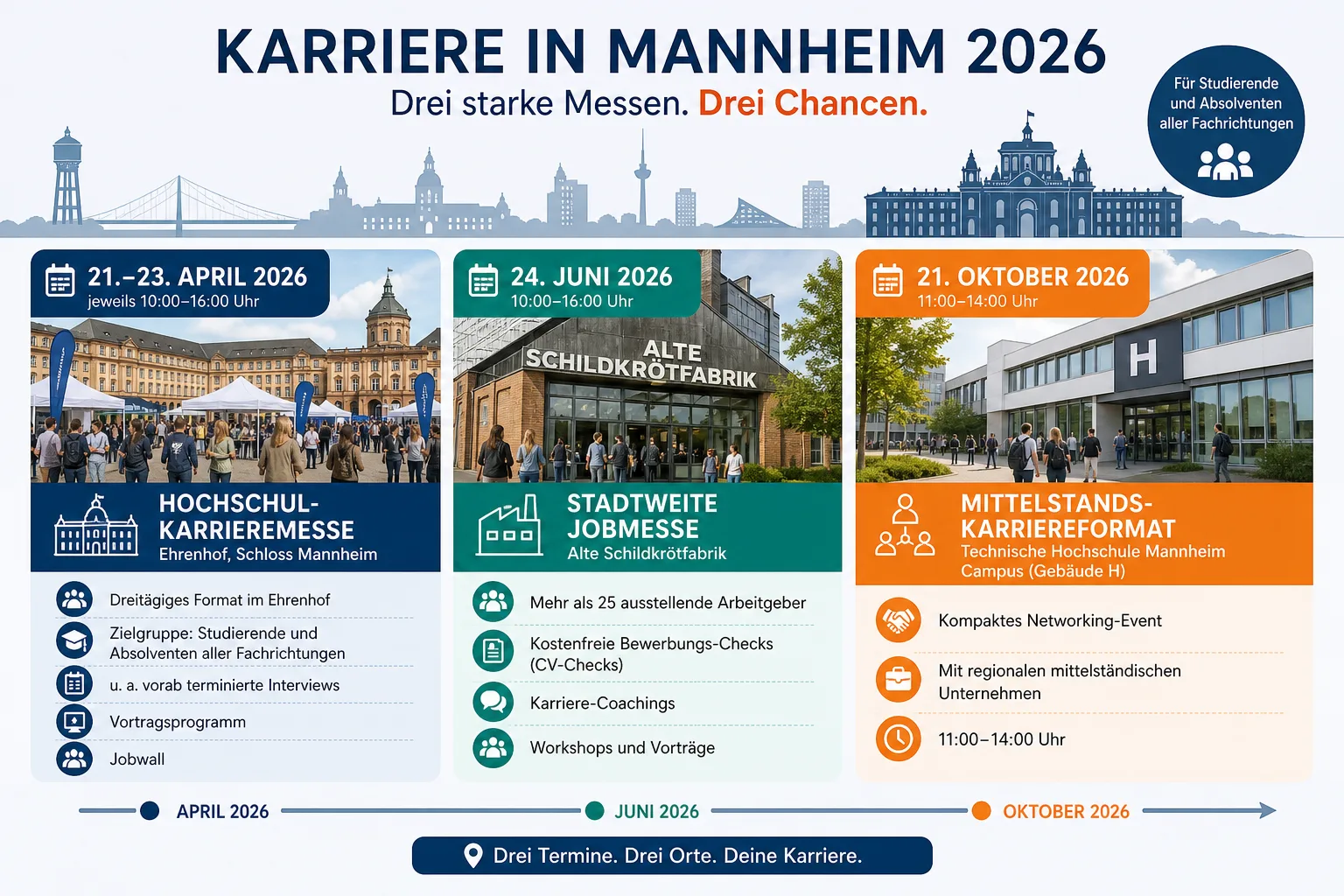
For the coming semesters, career fairs in the university context are particularly relevant in Mannheim. They are often aimed at students, graduates, and doctoral candidates – often interdisciplinary, sometimes also targeted (e.g. IT, Engineering, Business Administration, Data, Administration).
Typical Benefit: direct line to recruiters, information on entry programs, internships, working student positions, theses.Typical Components: company booths, presentations/employer talks, sometimes CV checks or short consultations.If available: appointment slots or matchmaking tools (e.g. pre-bookable conversations).
If you want to start specifically in Mannheim or the Rhine-Neckar region, these university formats are often the most efficient starting point, because many employers are explicitly looking for young talent there.
Citywide job fairs (independent of campus) are particularly interesting for the coming months if you are not (or no longer) just looking for “entry level”. These events are often more open and address not only students but also professionals, career changers, and returnees.
Typical Benefit: many industries in one place, low-threshold orientation, direct market check (“Which profiles are currently in demand?”).Common Supporting Program: application checks, short coaching sessions, workshops on job interviews or networking.Well suited for: reorientation, industry change, building a regional network.
Especially if you are considering several options in parallel, a citywide format is worthwhile because you can have comparative conversations in a short time.
For the upcoming recruiting season, compact networking formats focusing on regional medium-sized companies are also expected to remain attractive. They are often shorter than classic fairs and thrive on direct conversations without much “fair hustle and bustle”.
Typical Benefit: quick, deeper conversations; visible projects/tech stacks/departments; often concrete needs.Especially good if you: are looking for hands-on roles (e.g. engineering, IT, production, project management) or want to take on responsibility early.Success Factor: good preparation (questions, profile sharpening, 60-second introduction).
If you find SMEs exciting, such a format can be the most direct way to get to know “hidden champions” in the region.
Preparation: How to Get the Most Out of a Fair
1) Set a Goal (Beforehand, Not at the Entrance)
Set a clear goal for the next event – for example:
Orientation: 6–8 conversations to compare roles and industries.Concrete Application: 3–5 employers to whom you will apply within the next 72 hours.Network: 5 new contacts + 2 follow-up appointments (call/interview/info conversation).
2) Make Your Documents Fair-Ready
CV: up to date, easy to read, tailored to a target role (possibly two versions).Profile Headline: one sentence stating position + focus + added value.Work Samples/Portfolio: useful for IT/design/marketing/engineering (QR code or link list).
3) Check Exhibitor List and Prepare Questions
If the exhibitor list is published, create a priority list:
A-Goals (must): your top employersB-Goals (should): exciting alternativesC-Goals (can): “surprise conversations”
Prepare at least three concrete questions for each A-goal (examples in the On Site section).
On Site: Conversation Strategy, Questions & Follow-up
An Introduction That Works (30–60 Seconds)
A short, clear self-introduction is helpful at every event:
Example: “I am (name), studying/working as (field/role) and looking for a position in (target area) starting from (time). I am particularly strong in (2–3 skills/tools). What interests me most about your company is (team/product/location/project).”
Questions That Give You Real Information
Role & Daily Work: “What would I be working on specifically in the first 90 days?”Success Criteria: “How do you know after six months that someone is successful in the role?”Team & Collaboration: “How is the team structured (roles, seniority, interfaces)?”Development: “Which learning paths/trainings will be particularly promoted in the next year?”Recruiting Process: “What is the next step and until when does it make sense to apply?”
Immediately After the Conversation: Secure Follow-up
If you are seriously interested, ask for a concrete next step (e.g. application via portal + name of the contact person). Immediately note:
Name + function of the contact person
Keywords you referred to (project, team, technology, start date)
Which documents or links are requested
A follow-up on the next working day is usually ideal: short, precise, referring to the conversation and with a clear call to action (e.g. “Here is my profile/portfolio – is a 15-minute call next week possible?”).
What Suits You? Recommendations by Target Group
If You Are Studying or About to Graduate
Start with a university career fair to compare entry paths, internships, and working student roles.
Then use a citywide event to sharpen your documents through checks/coaching and to check alternatives.
Go to SME networking if you are looking for concrete practical projects, theses, or “hands-on” entry positions.
If You Have Work Experience or Want to Change
Prioritize citywide job fairs , as more seniority levels are often represented there.
Focus on targeted conversations : fewer booths, but deeper (90-day tasks, scope of responsibility, leadership).
Use networking formats if you are looking for regional employers outside of large corporate brands.
If You Are New to Mannheim/Rhine-Neckar
Use events as a “market scan”: Which industries are strongly represented, which skills are repeatedly in demand?
Ask specifically about locations, commuting options, hybrid rules, and onboarding.
Build a local network: A good contact can often give you more context than ten job ads.
Note (Transparency): This article is written as an outlook and orientation for upcoming dates. Binding information (dates, exhibitor lists, participation conditions) is published exclusively by the respective organizers on their official sites.
No Legal or Career Advice Substitute: The information is for general orientation and does not replace individual advice. If you want to read the provider's guidelines: Further information .
Sources & Further Links
Federal Employment Agency — Orientation on job search, application, and events (accessed 2026-11-04)University of Mannheim — Official university and career information (accessed 2026-11-04)Mannheim University of Applied Sciences — Official campus and career information (accessed 2026-11-04)City of Mannheim — Official city information and notes on events/location (accessed 2026-11-04)
Last reviewed: 2026-11-04