Further Education in Mannheim: Courses for Career & Profession
Further Education in Mannheim 2026/2027: Planned Opportunities for Mind & Career
In the coming months and into 2027, Mannheim is expected to continue to be one of the cities where professional further education is particularly visible and accessible: a strong job market in the Rhine-Neckar region, many learning formats (in-person, hybrid, live-online), and several government funding options that—if the requirements are met—can cover a large part of the costs.
This outlook summarizes what those seeking further education in Mannheim can expect in the near future: which formats can be planned, which topics are likely to remain in demand, and how you can prepare your entry so that counseling and funding work smoothly.
Funding 2026/2027: Which Paths Are Typically Open
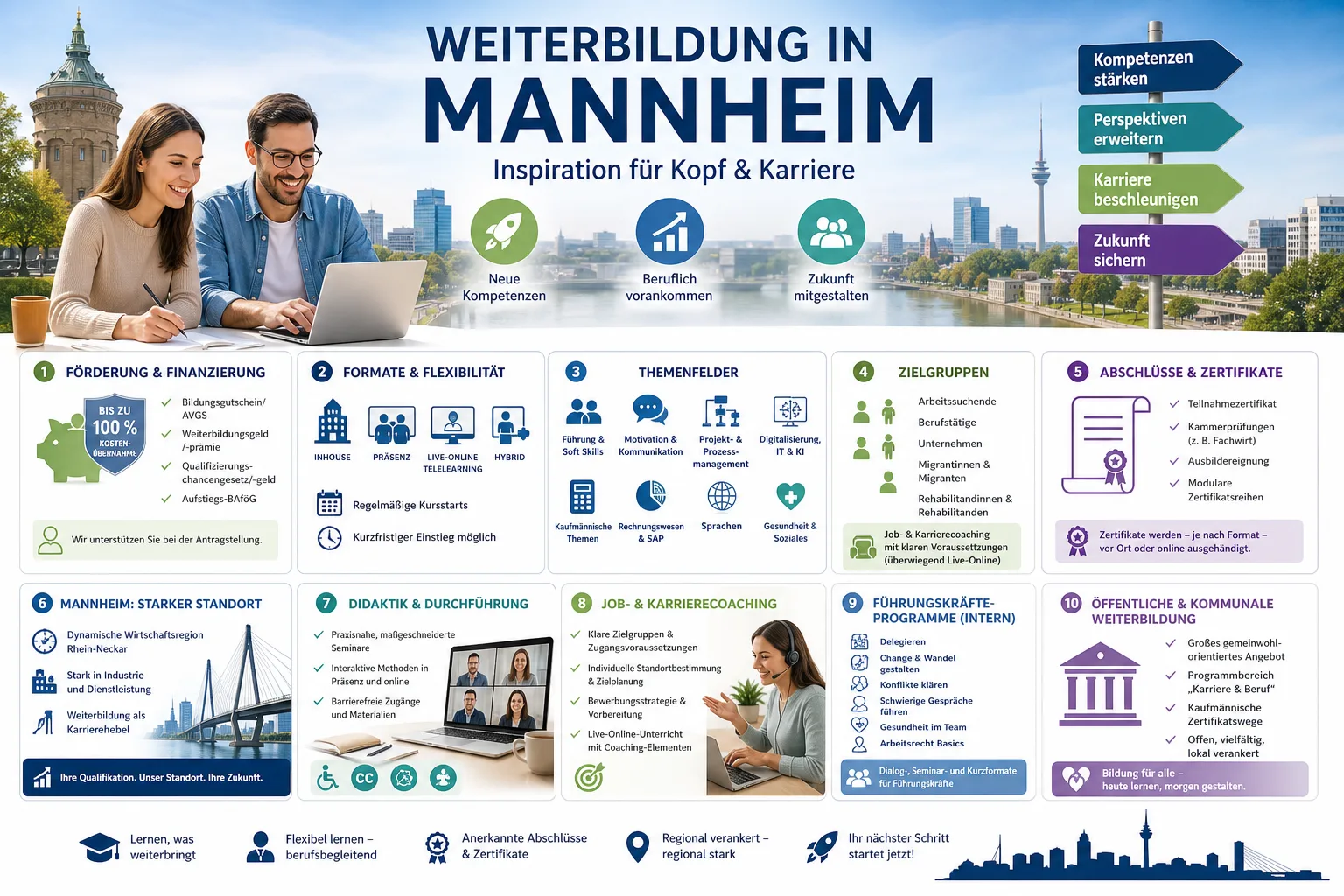
Even in 2026/2027, financing will be a decisive lever for many interested parties. The following funding instruments are expected to remain among the most important options. What remains crucial: Whether and to what extent funding is provided always depends on your individual situation, the specific educational goal, and the requirements of the responsible authority.
1) Funding for Job Seekers: Education Voucher and AVGS
- Education Voucher (Employment Agency/Job Center): can be used for approved further education if the measure is necessary for (re-)integration into work.
- AVGS (Activation and Placement Voucher): is often used for coaching, application training, or placement support.
If you are aiming for funded qualification in Mannheim in 2026/2027, it will probably be worthwhile to book counseling appointments early and clearly link the course data (duration, content, target qualification) with your integration goal.
2) Funding for Employees and Companies: Qualification (including under the Qualification Opportunities Act)
For employees, further education in 2026/2027 will often run through programs that help companies finance qualifications and cushion work absences. In practice, this is typically handled by the Federal Employment Agency. Those working in a company in Mannheim can particularly benefit in the future if HR and participants plan together (target role, skill gaps, time frame, proof formats).
3) Advancement Training: Advancement BAföG
If you are planning a recognized advancement training for 2026/2027 (e.g., towards master craftsman, business administrator, or comparable qualifications), Advancement BAföG will likely be a central component. Depending on the situation, it combines grant and loan components and can support course and examination fees.
How to Increase Your Chances of Funding (Without Empty Promises)
- Clearly formulate your goal: Which activity or position should realistically be achievable after the further education?
- Select a suitable measure: Content, duration, and qualification should plausibly lead to the goal (especially important for the education voucher).
- Prepare documents in good time: CV, proof of qualifications, course description, if applicable, job advertisements or competence profiles as justification.
Note (Transparency): Statements such as “100% cost coverage” are always subject to conditions in practice. For 2026/2027, you should therefore obtain binding commitments exclusively in writing from the responsible authority (Employment Agency, Job Center, BAföG office, or relevant funding body).
Formats That Can Be Reconciled with Life & Work in the Future
For the coming months, it is expected that providers in Mannheim will continue to focus heavily on flexible learning models. This will remain particularly relevant for participants with changing work schedules, caregiving responsibilities, or longer commutes.
- In-person formats (evenings/weekends): will likely be preferred where practice, feedback, and group dynamics are central (e.g., communication, leadership, facilitation).
- Live-online trainings: are expected to continue to grow in Mannheim in 2026/2027, as they combine scheduled sessions with location independence.
- Hybrid models: will likely be particularly suitable for longer qualifications (e.g., a mix of in-person workshops and online self-study phases).
- In-house further education: will continue to be an important way for companies in Mannheim to uniformly qualify teams (e.g., process standards, new tools, leadership culture).
If you want to start in 2026/2027, early coordination will probably pay off: weekly time budget, desired learning format, exam or certificate goal, and the question of whether a provider offers digital learning platforms with performance records (important for proof to employers and funding bodies).
Future-Oriented Topics: From Leadership to Digitalization
For further education planning in Mannheim from 2026 onwards, it can be expected that certain topics will remain in demand in the long term—especially where companies feel pressure to transform or new role profiles are emerging.
Leadership, Communication, and Collaboration
Seminars on modern leadership, conflict resolution, conversation management, and team control will likely remain important—especially as many organizations will increasingly focus on hybrid collaboration, employee retention, and internal development.
Project, Process, and Quality Management
Structured methods (classic or agile) will also remain relevant in many companies in the region in 2026/2027. Courses on project management, process optimization, and quality standards can therefore still be expected in Mannheim.
Digitalization, Data Literacy, and AI Applications
In the coming months, it is expected that digital basic skills and practical AI topics will continue to be expanded—e.g., secure tool use, automation, data protection basics, and classifying AI results in the work context. Especially for AI, in 2026/2027, the ability to check results, recognize risks, and responsibly shape processes will likely count.
Commercial Qualifications
Accounting, controlling, HR processes, and application-oriented software skills will likely remain stable classics—often modular, so that learning progress can be demonstrated in stages.
Languages & Intercultural Competence
As an internationally shaped economic area, the Rhine-Neckar region is also expected to have a strong demand for language and communication skills in 2026/2027—for customer contact, internal coordination, and presentations.
Health and Social Affairs
For Mannheim, it can be expected that further training in the health and social sector will continue to play a major role—from communication and team leadership to quality-assuring standards that organizations will have to reliably implement in the future.
How to Plan Your Entry: Step-by-Step to Course Start
If you want to start your further education in Mannheim in the coming months, a clear sequence will usually speed up the process significantly—especially if you want to apply for funding.
-
Define your target image for 2026/2027
Formulate a concrete result: new role, expanded area of responsibility, change of industry, or recognized qualification. The more concrete the goal, the easier it will be later to select the appropriate measure and justify it to funding bodies.
-
Determine suitable format and proof form
Decide whether you are aiming for a certificate, an exam, or a recognized qualification. Then plan the format (in-person/live-online/hybrid) so that it is realistically sustainable.
-
Obtain funding advice before binding booking
If you want to use funding in 2026/2027, you should clarify before signing a contract which requirements apply and which documents are needed. This way you avoid incurring costs that are not covered later.
YMYL Note (Finances/Benefits): This article serves as guidance for future planning in Mannheim. Funding decisions, eligibility requirements, and funding amounts may change and are determined exclusively by the responsible authorities.