Zero Waste Events: Mannheim Celebrates Sustainably
Zero Waste & Green Events: How Future Events in Mannheim Celebrate Sustainably
How can you plan an event in Mannheim so that after the last song, there aren’t mountains of trash left behind—but a venue that’s quickly clean again? This guide is for anyone who wants to organize upcoming private parties, club festivals, cultural events, or corporate gatherings in Mannheim as a Zero-Waste and Green Event.
The focus is on the most effective levers for the future: Waste prevention (not just separation), reusables, smart mobility for guests, and catering that prevents food waste. The tips are formulated so they work for small gatherings as well as larger event formats.
Vision: Zero Waste as the Standard for Future Events
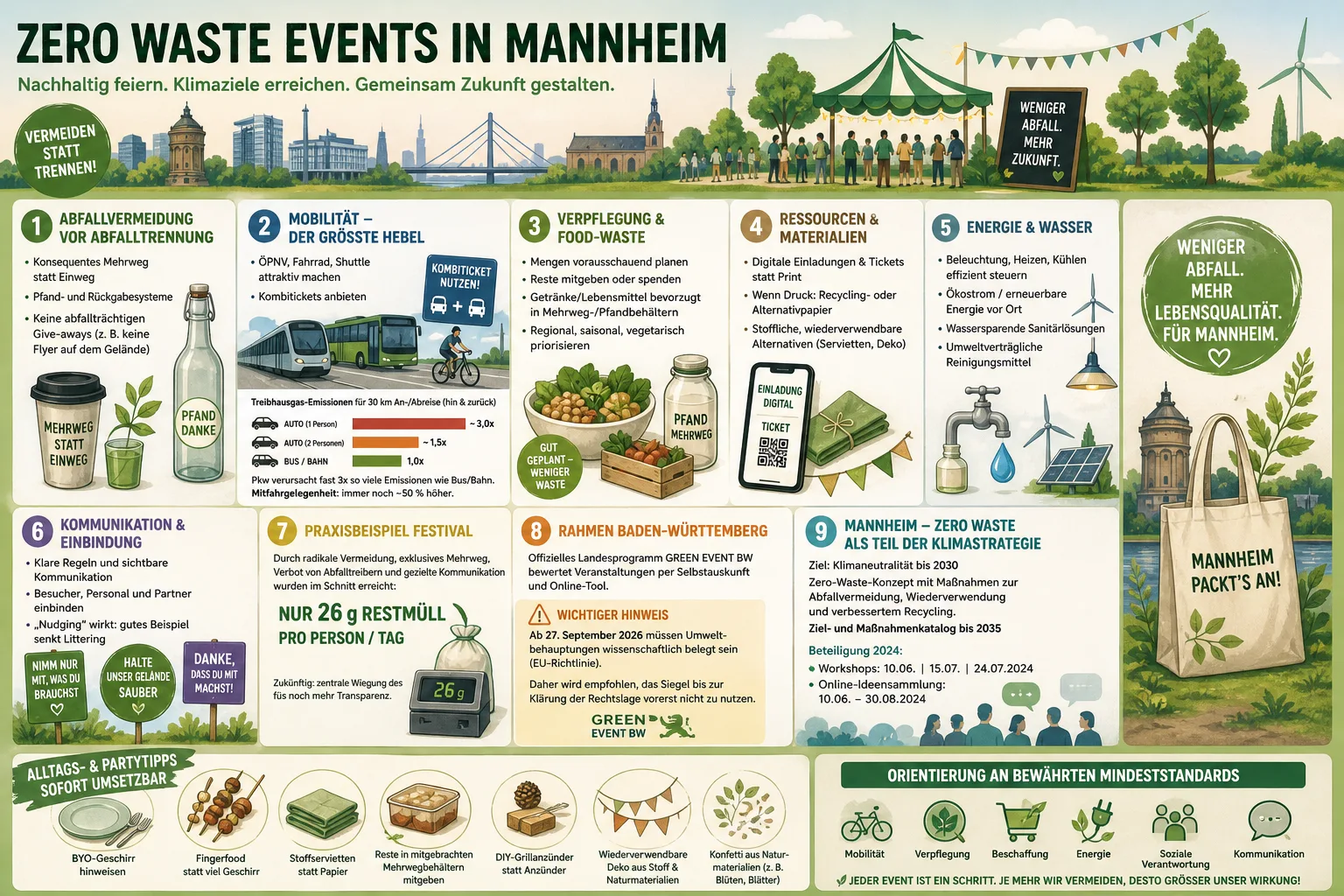
For future events in Mannheim, it’s worth making Zero Waste not an “extra,” but a planning standard: Resources should ideally never become waste in the first place. This follows the established logic of the waste hierarchy: First avoid, then reuse, only then recycle—and only as a last resort, dispose.
In practice, this means: Even during the concept phase (venue, ticketing, equipment, catering, arrival), decisions are made that later determine waste volumes, costs, and audience acceptance. Early planning can achieve more impact with less effort.
Avoid Waste Instead of Just Separating
Waste separation is important—but for upcoming Green Events, prevention is the stronger lever. Separation only comes into play once waste has already been created. Prevention reduces material use, transport, cleaning, and disposal from the start.
- Eliminate single-use triggers: Single-use decorations, giveaways, unnecessary printouts, disposable cutlery, and portion packaging are consistently avoided or replaced with durable alternatives.
- Simplify procurement: Fewer item types (e.g., one cup type, one plate format) make returns, washing, and logistics easier.
- Make waste sources visible: In the planning phase, for each area (entrance, bar, stage, sanitation, backstage), note what waste typically arises—and how it will be prevented.
Ambitious target values are realistic in the future when reusables, clear rules for vendors, and good guest communication work together. What matters is not perfection, but a measurable reduction in residual waste and a stable, stress-free process.
Reusable Systems That Work in Everyday Event Life
For upcoming events, reusables are usually the biggest single step toward Zero Waste. For reusables to really work, clear processes are needed: distribution, return, deposit logic, washing capacity, and responsibilities.
How to Implement Reusables Reliably
- Contractually require reusables: Food trucks, bars, and caterers are required from the outset to serve food and drinks in reusables (including deposit and return process).
- Make returns easy: Multiple return stations, clearly visible, with short distances. For larger areas, additional return points can noticeably reduce bottlenecks.
- Organize washing & hygiene properly: For indoor locations, use the existing washing infrastructure; for outdoor formats, plan for a professional washing service or a mobile solution. This reduces risk and stress.
- Don’t forget backstage: Crew, artists, and service providers also get reusables (water station, pitchers, reusable boxes) instead of disposable bottles and to-go packaging.
Arrival & Mobility: The Biggest Climate Lever
For many event formats, a large part of emissions comes from arrival and departure. For upcoming events in Mannheim, it’s therefore worth making mobility a fixed part of planning—just like stage, bar, or security.
Measures That Scale Well for Future Events in Mannheim
- Clearly prioritize public transport: On the website, tickets, invitations, and social media, stops, lines, schedule info, and accessible routes are prominently mentioned. A well-visible “How to get here” section reduces questions and car trips.
- Make cycling attractive: Sufficient bike parking in sight of the entrance, good lighting, and (if possible) a supervised area. This makes cycling more realistic even in the evening and for longer stays.
- Consciously manage carpooling: If car arrival is unavoidable, carpooling tips (e.g., “Please come with two or three people per vehicle if possible”) and clear parking communication help reduce unnecessary single occupancy.
- Shuttles for peak times: For larger events, a shuttle between central hubs (e.g., near the train station) and the event site can bundle traffic. Important: Communicate departures so that waiting times remain short.
Mannheim basically offers good conditions for future events, as many locations are accessible by tram, bus, and train. The earlier these options are integrated into guest communication, the greater the effect.
Catering Without Food Waste: Enjoyment With a Clear Conscience
For upcoming Green Events, catering can be both a highlight and a source of waste. With good planning, both costs and environmental impact decrease—without loss of quality.
Four Levers for Future Zero-Waste Catering
- Calculate needs realistically: Quantity planning is based on event duration, target group, weather risk, and time of day. For longer formats, staggered serving (restocking instead of “putting everything out”) can reduce overproduction.
- Vegetarian/vegan as the standard option: A high proportion of plant-based dishes can reduce environmental impact and is often easier to store and serve in practice.
- Buy regional & seasonal: Short supply chains and seasonal products make planning easier and can increase freshness and acceptance.
- Safely distribute leftovers: If legally and organizationally possible, leftover food is distributed in a structured way after the event (e.g., “leftover station” in reusable boxes) or passed on via suitable local structures. This is considered in hygiene planning in advance.
For future private parties in Mannheim, many things are easy to implement: water in carafes, large bowls instead of individual portions, cloth napkins, and a clear plan for how leftovers are distributed at the end of the evening.
Materials, Energy & Water: Thinking of Green Events Holistically
Invitations, Tickets, Signage
- Digital first: Invitations, maps, and programs are preferably provided digitally (e.g., mobile-optimized page instead of multi-page printouts).
- If printing is necessary: Recycled paper, small print runs, and clear, reusable signage (neutral signs without dates) reduce waste across multiple events.
- Use rental and leasing models: Furniture, decorations, and technology are preferably rented or borrowed instead of being newly purchased and then stored or disposed of.
Energy
- LED & demand-based control: Energy-efficient lighting, sensible switching times, and realistic power planning reduce consumption and technical risks.
- Electricity from renewable sources: For future indoor events, a green electricity tariff from the operator can be a simple, effective step. Outdoor events plan power needs so that generators are reduced or operated efficiently.
Water & Sanitation
- Water stations instead of disposable bottles: Drinking water points (with clear signage) reduce packaging and improve comfort.
- Environmentally friendly cleaning agents: For cleaning and sanitation, products are preferred that are as gentle as possible on water bodies and materials.
Communication, Participation & Practical Mannheim Tips
For upcoming events, communication determines whether rules are seen as a burden or as a joint project. Good communication is concrete, friendly, and visible—and briefly explains the “why.”
Clear Messages Instead of Pointing Fingers
- In advance: The invitation/ticket lists in 3–5 points what guests can expect (reusables, travel recommendation, water station, no single-use confetti).
- On site: Short, clear signage at return and collection points; if needed, volunteers provide “friendly guidance” instead of control.
- Afterwards: A brief review (e.g., “This much residual waste was generated” / “This many guests came by public transport or bike”) increases learning effects for the next event.
Orientation Through Criteria Instead of Marketing Promises
Anyone calling future events “green” should make the measures transparent: What decisions were made (reusables, mobility, catering, procurement) and how were they implemented? This builds trust and reduces the risk of misleading environmental claims.
Low-Waste Tips That Work Immediately for Upcoming Events
- “Bring your bottle”: Guests are invited to bring a water bottle; there is a well-signposted refill station on site.
- Reusable decorations: Fabric garlands, string lights, plants (for rent or multiple use) instead of short-lived single-use decorations.
- Clear routing: Drop-off and return points are located where people naturally pass by (entrance/exit, bar, near restrooms).
- One team member as “Zero-Waste Lead”: Clear responsibility ensures that reusables, signage, and returns don’t get lost in the hustle and bustle.
Short Checklist for Planning (Future Events)
- Concept: What waste sources are likely—and how will they be prevented?
- Reusables: Define cups/dishes/boxes, plan deposit & return, secure washing capacity.
- Arrival: Prominently place public transport & bike info; manage parking communication; check shuttle if needed.
- Catering: Quantity planning, plant-based options, reusable serving, leftover management.
- Material: Digital instead of paper; reusable signage/decor; use rental/lease.
- On-site setup: Return and collection points along walkways; clear, short instructions.
- Follow-up: Document results and improve for the next event.